Natural Eczema Relief for Children
[written by Brisbane Naturopath & PAT Practitioner Belinda Byrnes]
If you’re a parent of a child that suffers from eczema, you will know what it’s like trying to figure out what foods or environmental factors might be triggering flare ups.
Cutting out foods or whole food groups, changing all the household products, watching the skin, reintroducing something, thinking you might have finally got it, then second-guessing everything when a new flare appears.
And it never fully cleared up anyway, so is all that stress even worth the effort?! You’re not alone. I talk to so many parents who are going through this exact same thing: It’s exhausting. It’s confusing.
And it can start to take over mealtimes, your brain space, shake your confidence, and really have a major impact on the whole family.
You just want to help your child feel better. But with so many possible triggers (and so much conflicting advice online), it’s hard to know where to start — or when to stop.
These are the patients that I work with every day and in this blog, I want to take the pressure off a little. I’ll walk you through some of the most common concerns and struggles I hear from parents when we first start working together.
Whether you’re just starting to suspect that some foods might be causing flares, or you’ve already been on this long and frustrating journey and are completely at your wits end, I hope this gives you some clarity, some reassurance — and options for a more manageable path for natural eczema relief for children.
Belinda’s Naturopathic Approach

Conventional eczema treatment would have you believe that your only real options are to identify the triggers and avoid them, which is not as easy as it sounds, that’s for sure.
In the meantime, suppress the symptoms with a variety of creams, (some with questionable safety profiles), increasing the strength of these creams if the weaker ones no longer work, and wait and hope that they grow out of it!
From a Naturopathic perspective, I look at things a little differently. Unless there’s an obvious reaction or flare after consuming a particular food or food group, going down the food elimination rabbit hole — especially in young children — can quickly become very overwhelming. And if you’re breastfeeding, you would need to eliminate those foods as well.
The truth is though, that food elimination and restrictive diets can be problematic as well – especially for little ones and breastfeeding mothers who need plenty of nutrients to grow and heal.
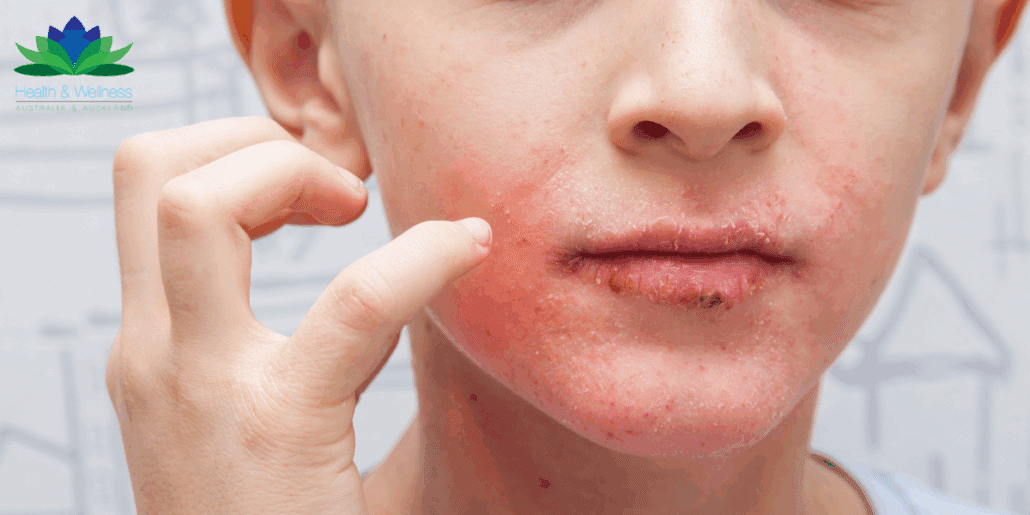
Not only is there the stress of constantly second-guessing meals, googling ingredients, and wondering if the rash around their mouth means the porridge was a problem, or was it something they had at grandma’s, or daycare?? It’s exhausting.
And often, despite all the effort, the eczema stays exactly the same or you see some minor improvement.
The Impacts of Elimination Diets

Food elimination can potentially lead to:
- Nutrient deficiencies or insufficiency (especially if multiple foods and food groups are removed)
- Poor appetite or picky eating habits
- Increased food fear and anxiety (for both you and your child)
- Extra mental load and emotional stress for the entire family
- Disrupted mealtime routines
- Strain on the parent-child relationship around food
- For breastfeeding mums, feeling constantly responsible and restricted which can lead to issues with milk supply
And the reality is that it can be almost impossible to work out because it can be a combination of foods that are contributing, and often the reactions or flares will be dose dependant.
For example, they may not have reacted to avocado on toast last week but today had a huge flare after avocado – it may not be the avocado itself, but this time there had been a lot more high salicylate foods consumed over the past couple of days, which was enough tip the avocado into flare up status this time around.
So, as you can see, for many people it can be complicated, and can be almost impossible work out.
Let’s look at it this way though:
Instead of asking “Which foods do I need to cut out?” it’s often more helpful to ask: “Why is my child reacting to food in the first place?”
Because even if you do get to the bottom of what’s causing the flares and can actually avoid them, do you need to do that forever?? What happens when they’re a bit older and you can’t keep and eye on everything they’re eating? Is it even sustainable to be able to eat that way long term?
In most cases the food isn’t the real problem. It’s just showing you that something deeper needs support — whether that’s the digestive system, the immune system, the skin barrier, or all of the above. Without really addressing why the body is so sensitive in the first place, it can be very difficult to get long lasting relief.
Food reactions are often a symptom of an overloaded or out of-balance body. When we shift focus toward reducing that over-reactivity, calming inflammation, strengthening the gut, and supporting the skin from the inside out, food often becomes much less of an issue — and we can bring back more freedom at mealtimes, and in life in general!
Causes of Childhood Eczema

So, what causes this over-reactivity?
There are a lot of contributing factors, and the combination of these will differ for everyone, but here are a few of the more common ones:
- Being born via C-section (1) (which alters early gut colonisation)
- Recurrent use of antibiotics or antibacterial products
- Genetic factors
- Nutrient deficiencies (zinc, vitamin D, essential fatty acids, etc.)
- An imbalance in the microbiome in the gut and/or skin
- Less early exposure to natural, outdoor environments
- Poor sleep
- Bottle feeding vs breast feeding (2)
- Highly processed foods and high sugar diets
All of these factors can stress the digestive and immune systems, making the body more reactive to otherwise harmless foods. So while you can keep trialling elimination of foods, you’re often just chasing symptoms around the plate — instead of calming the underlying inflammation and restoring balance.
That’s not to say food doesn’t matter — it absolutely does. But it matters more in context. When we support the gut, skin, and immune system at the same time, food becomes less of a battleground. And that’s when natural eczema relief for children really starts to unfold — without the constant fear around what’s on their plate.
Natural Eczema Relief for Children with PAT

This is where Positive Association Technique (PAT) comes in. We can helps provide natural eczema relief for children by reducing the sensitivity to foods and environmental factors, without needing to rely on long-term restriction. It also helps removes the guess work – which is one of the big frustrations for families of kids with eczema.
In a PAT session we are using gentle and non-invasive muscle testing or kinesiology (that can be used on children of any age, including babies with a parent as surrogate), and in this way we can identify problematic foods and airborne substances that can be contributing to flares.
We are also able to pick up problematic foods and substances that may not have been picked up in more conventional allergy testing. Because we aren’t limited by testing parameters like IgE levels, some sensitivities or intolerances are not mediated in that way, and therefore won’t show up on Skin Prick Testing (SPT).
It’s very common for clients to tell me that their skin prick testing came back ‘fine’, to things that they are 100% certain cause flares for their child. Some children will be reactive from a very young age and conventional allergy testing isn’t always appropriate either.
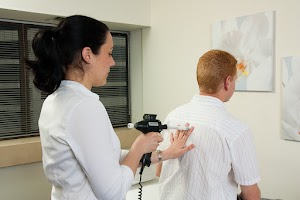
After the muscle testing component, we then use a chiropractic tool called an ‘Acustim’ to gently stimulate acupressure points down either side of the spine, while you’re holding onto a sample vial of the food, to help recalibrate your body’s response and relieve the symptoms of the reaction.
In this way we can give your child, and you, some breathing room with less sensitivity, reduce the regularity of flares and need for food restriction, so that the body can begin to heal.
To learn more and see if PAT is right for you;
– Request a Free PAT Information E-PACK
– Call us on 1300 853 023 / 09 479 5997 (NZ) to chat to our friendly head office team
Reducing Reactivity and Building Resilience

I’m a mother of two young boys myself and I’ve been on my own journey with skin issues and food restriction. I know what that’s like and how stressful it can be, and my focus with the families I work with is always going to be on implementing the simplest and most gentle strategies to start bringing down that heightened reactivity, so they can feel more comfortable in their skin now, while also gently rebuilding the foundations for long-term resilience.
When you can consume a wider range of healthy foods, reduce itching and therefore improve sleep and reduce the stress on the family unit, you have more space to address the bigger picture as needed:
– Supporting the gut lining and microbiome
– Addressing immune system dysfunction
– Strengthening the skin barrier
– And making sure they’re actually absorbing the nutrients they need to heal
When we take this kind of whole-body approach, food becomes less threatening. Their world opens up again — more foods, more fun, less fear. And for parents? A lot more peace of mind.
My goal is to change the focus of natural eczema relief for children – because what I see is a lot suppression and what we need to avoid, and this isn’t a family friendly approach to treatment, and it often doesn’t get results, leaving families feeling so frustrated and disheartened and not knowing what to do next.
I want people to know that, that’s not the only way. Long-term eczema healing is about nourishment and repair – it’s about building the body back up to be stronger, more resilient and less reactive.
If you’ve been stuck in the cycle of eliminating foods, watching for flares, and still not seeing progress — you’re definitely not alone.
If you’re ready to take a gentler, more strategic approach to managing your child’s eczema, then a PAT practitioner is the perfect starting place as we are all qualified naturopaths as well.
Next Steps
Belinda Byrnes is a Naturopath, Nutritionist & PAT Practitioner based in Gaythorne, Brisbane, and also provides Naturopathic Consultations online.
To book in for a Positive Association Technique (PAT) consultation, use our online booking system or call us on 1300 853 023 (Aus) / 09 479 5997 (NZ).
To book a Naturopathic Consultation with Belinda, visit her website – https://www.theeczemanaturopath.com.au/
Please note that this blog post contains general information only. Always consult your health care professional before changing your diet, starting new supplements or regarding any medical condition.